-


Over 1,000 Autistic Children Had Proven Clinical Outcomes From ABA, Says Ashly Joys Of Behavioral Innovations
Read more: Over 1,000 Autistic Children Had Proven Clinical Outcomes From ABA, Says Ashly Joys Of Behavioral InnovationsYou’ve seen the headlines. “1,141 children.”“National clinical standard.”“Published outcomes.”“ABA therapy shown effective.” “We take pride in the work of improving our craft,” said Ed Maher,…
-


Trauma-Informed ABA: Empathy in the Marketing, Reinforcement in the Room
Read more: Trauma-Informed ABA: Empathy in the Marketing, Reinforcement in the RoomThe recent push to describe Applied Behavior Analysis as “trauma-informed” represents a disciplinary adaptation to criticism, not a structural transformation of the field. The paper…
-
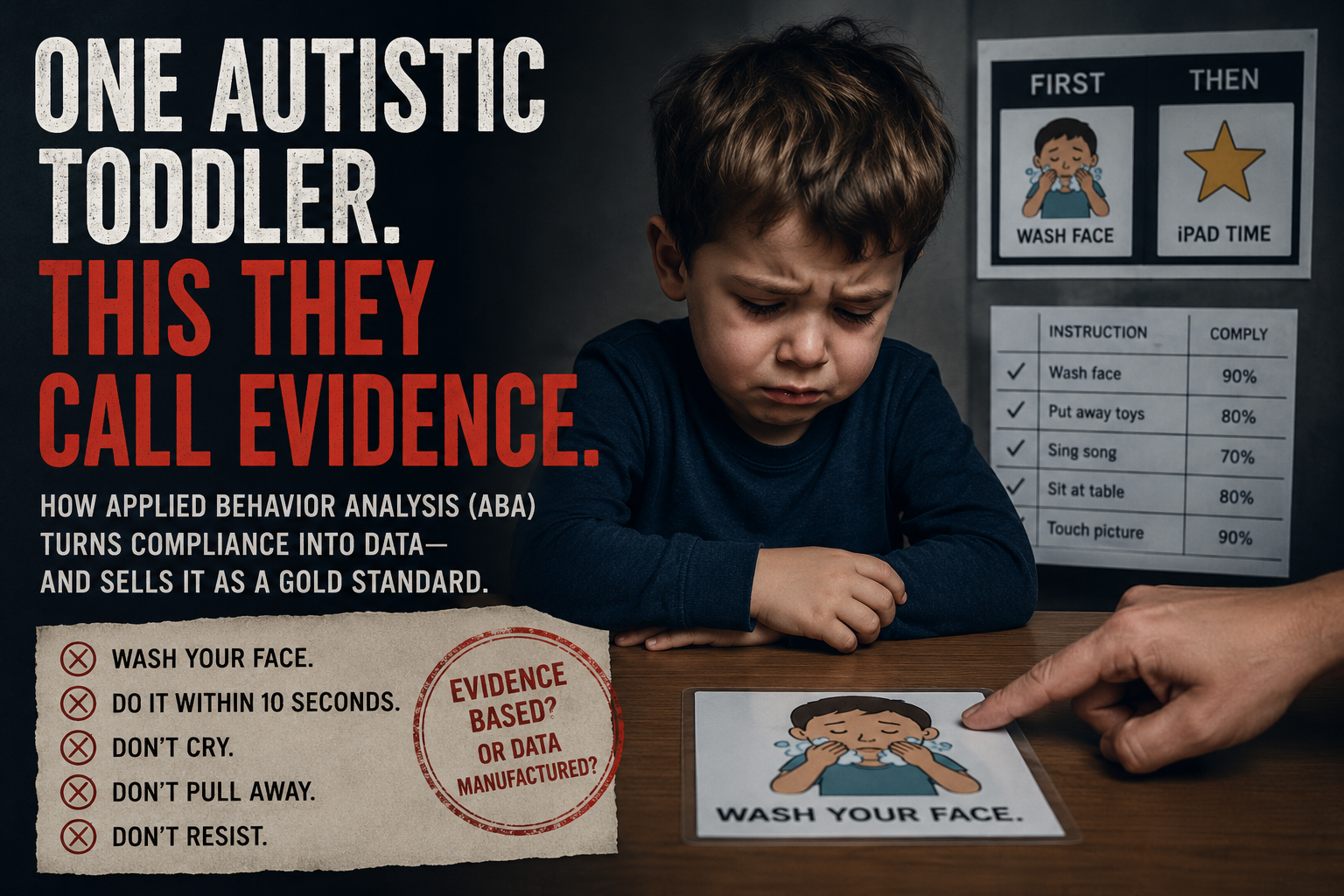

One Autistic Toddler Becomes “Evidence”
Read more: One Autistic Toddler Becomes “Evidence”In March 2026, Lyftingsmo and colleagues published a study in the field of Applied Behavior Analysis (ABA) claiming that a method called Errorless Compliance Training…
-

“Take Off Your Shirt”: When Compliance Training Crosses The Line Into Harm.
Read more: “Take Off Your Shirt”: When Compliance Training Crosses The Line Into Harm.In May 2026, Ashlyn McChristie and David A. Wilder published Teaching Young Children With Autism: When Not to Cooperate With Instructions in the Journal of…
Writing Pillars
For responsibility, consent, and human consequence.
What is claimed versus what is demonstrated
How vulnerable populations are represented in research
Where responsibility is deferred to procedure or credential
Ethics, in this project, is not an abstract principle. It is a practical question about how knowledge is produced, how authority is exercised, and how harm is acknowledged or avoided when human lives are involved.
For whose knowledge counts and who bears the cost.
Whose expertise is recognized as legitimate
Who is spoken for, and who is spoken over
How authority is distributed in autism research
This pillar examines how professional hierarchies shape what is heard, what is dismissed, and what becomes common sense—especially when autistic-led perspectives are positioned as anecdotal rather than evidentiary.
For claims, methods, and scientific accountability.
What behaviorism counts as evidence
How “gold standard” status is constructed
Where methodological limits are minimized or obscured
Evidence here is treated as a social-scientific problem, not a branding term. This pillar focuses on how confidence is conveyed, how rigor is signaled, and how uncertainty is managed—or avoided—in professional writing.
For power, governance, and professional self-regulation.
How disciplines police their boundaries
How citation, review, and credentialing function as control
How authority is stabilized through procedure
Institutions examines how systems maintain legitimacy over time, not through open debate, but through norms that shape what can be published, cited, funded, or taught.
For students, families, policymakers, and autistic people.
Who is asked to trust expert claims
Who makes decisions under urgency
Who lives with the long-term consequences
This pillar centers the audiences most affected by behaviorist authority—those who must navigate claims presented as settled science while lacking access to the tools needed to evaluate them.
For oversight, restraint, and humane limits.
How citation becomes governance
How review becomes regulation
How exposure is reduced without refutation
Safeguards examines the mechanisms used to manage dissent, contain critique, and protect institutional reputation under the language of responsibility and professionalism.
 Misbehaviorism .com